



How to Verify Photos and Videos
Several instances of manipulated or misrepresented visual content concerning the conflict in Israel and Gaza have surfaced and Raskrinkavanje has debunked many of them. For example, a video of children in cages circulated with the false claim that they were Israeli children kidnapped by Hamas. The recording was, in fact, made before the escalation of the conflict on October 7. Raskrinkavanje also wrote about the video of the bombing in Sudan, which was wrongly presented on social media to have taken place in Gaza. Additionally, there were false claims circulating of about a year-old video depicting the arrival of American soldiers in Romania, erroneously portrayed as a “landing of marines in Israel.” A photoshopped image from a satirical website falsely indicated that the people of Sarajevo showed support for both Israel and Palestine at a single rally. Similarly, a fabricated photo, purportedly showing Atletico Madrid fans displaying a large Palestinian flag, was shared with no basis in reality. Since such content spreads fast on social media, it is important for the users to be able to verify the content themselves. We will share some easy ways to verify content online. By employing reverse image searches on search engines like Google, Bing, Yandex and Tineye, one can trace the origins of the visual content. Through this search, you can uncover the initial appearance of the photo, often accompanied by details about its origin and content. Even if this information is not readily available, the original publication date can serve as a vital clue. For instance, if a photo is purported to have been recently taken at a specific location, but you find it has been circulating online for years, it raises red flags. These search engines also yield results with similar images, enabling you to identify any potential alterations made to the photo you are investigating. To perform a reverse search, you need to add a photo from your device or the URL of the photo if it is already online. For more comprehensive results, it is advisable to search on as many platforms as possible. An extension called RevEye Reverse Image Search allows you to perform a reverse image search on all four search engines at the same time by simply right-clicking on the photo you want to search.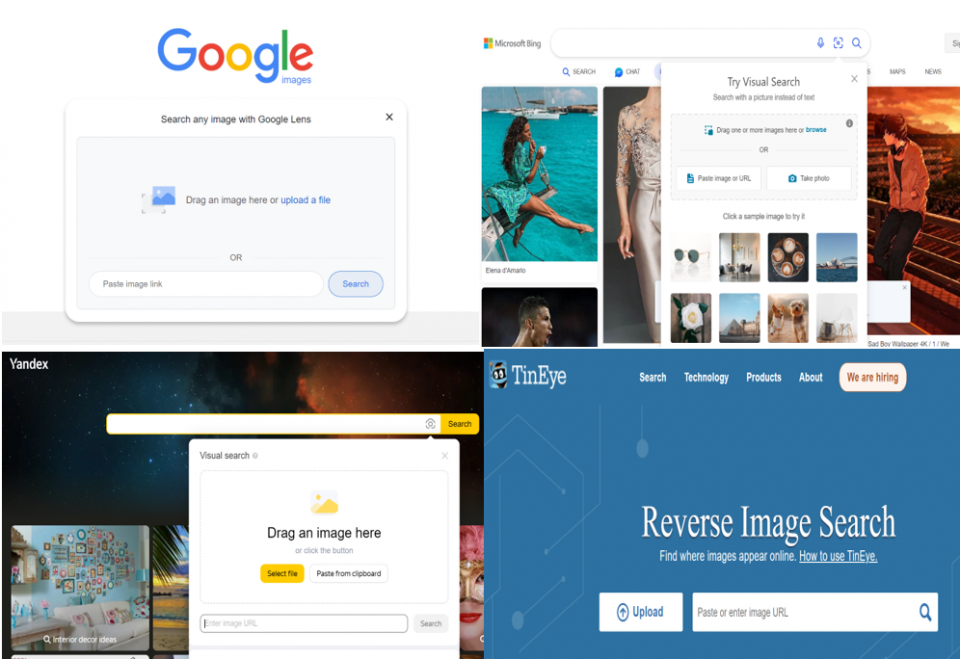 The process of video authentication follows a similar approach. Begin by capturing a screenshot of a frame from the video and utilize the reverse photo search feature on one or multiple search engines. Similar to searching for an image, you can sift through the results to locate the initial publication of the video online. For the best outcomes, it’s recommended to capture a screenshot of the title frame or video thumbnail.
 Assessing Source Credibility
Social networks can be vital for sharing information quickly and efficiently. However, when receiving information from these platforms, it is crucial to pay attention to the source, considering that almost anyone can post anything on them without any prior independent verification. Raskrinkavanje’s “Media Literacy” website provides guidance on identifying credible sources of information on Facebook. It is necessary to pay attention to the section “About us” or “About” on the Facebook page, where there should be information about the page’s management, as well as information about its vision, mission, goals and history. The more information there is in this section, the more likely it is that it is a credible source. Also, it is important to verify the contact information of the individuals or team managing the page, as well as their website or media references and visual identity. These parameters can also be used to assess the credibility of sources on other social networks, such as Instagram and TikTok. Verification indicators, like the “blue tick” on certain social networks can also be a sign of credibility, confirming that the page represents a real person, company or entity. However, the fact that a page or account represents an authentic person or entity does not necessarily mean that the information published on it is credible. In addition to sources from social networks, it is important to know how to assess the credibility of media sources and information. The “Media Literacy” website explains:However, a media outlet can meet all standards of credibility and still publish incorrect information. Therefore, it is important to check whether the media report contains all the necessary elements of a credible media report. Credible media bear the responsibility of substantiating their information with evidence and sources, including documents, photographs, recordings, and statements from individuals with firsthand knowledge of the discussed subject. However, as highlighted on the “Media Literacy” page, when a media outlet relies on the statement of an individual, it is imperative to consider the following aspects to ascertain the reliability of the source:Anonymous “media” do not exclusively publish fake news, as they often take over the publications of credible media, adding clickbait headlines to them to present them as exclusive information that no one else has published. However, if the “exclusive news” first appeared on a web portal that publishes unsigned articles, and has no imprint or information about ownership and editorial – it is probably not true.
Therefore, the first step of verification is to “get to know” the media that published the information. Information on editorial and media ownership is usually found in the “About Us”, “Impressum” or “Contact” sections, which can be found at the top or bottom of the page, or in its menu. If such sections do not exist or do not contain the names and surnames of the people who edit the page, you are probably not looking at a media outlet, but a page whose sole purpose is to make money from Google ads or the “bulletin board” of a political actor.
(…)
Another indicator of the credibility of a media source is its general tone and appearance. If you are on a web portal that is red with headlines that promise exclusive, scandalous and incredible content, approach all the information it publishes with caution. The same applies to web portals that seem “strange” – they do not have standard sections that can be found in legitimate news media, they have more ads than real content, they have ads that “pop” off the page, they are full of spelling mistakes in the titles, etc.
During times of armed conflict, it’s crucial to view claims from the active participants, such as governments, institutions, or military forces, with a level of skepticism if they lack concrete, verifiable evidence. A few days following the Hamas attacks on Israeli territory, numerous media outlets globally, including Southeast Europe, reported a claim that members of the militant group were beheading infants in the town of Kfar Aza. The claim was based on an Israeli media report, which referred to statements by Israeli soldiers, and was then shared by Israeli political and military officials. Not long after, it was spread by officials and media from other countries, without undergoing critical examination or scrutiny. Nevertheless, our analysis reveals that no evidence has ever been presented to confirm the truth of these allegations, and even some Israeli military officials refuted their earlier statements, stating that they cannot confirm that such a crime actually took place. Therefore, when reporting on events related to any conflict, it remains imperative to scrutinize whether claims from official sources have been independently verified by the media or reputable organizations.– Does the statement pretend to present facts or personal opinions, attitudes and assumptions?
– If it is about stating factual knowledge, has the person who is the source of the information clearly stated how he came to the knowledge that he is making public? Are these findings based on verifiable facts?
– Is the person who is the source of the information professional and competent to present conclusions on a certain topic? What is her educational and professional profile and what knowledge and experience does she have in the field she is talking about?
– Does the person speaking about the controversial topic show a strong affection towards one side in the “dispute” or can he be considered neutral concerning the controversy itself?
– Does the person talking about a controversial topic have a personal (political, financial or other) interest that can motivate him to present incorrect information?