



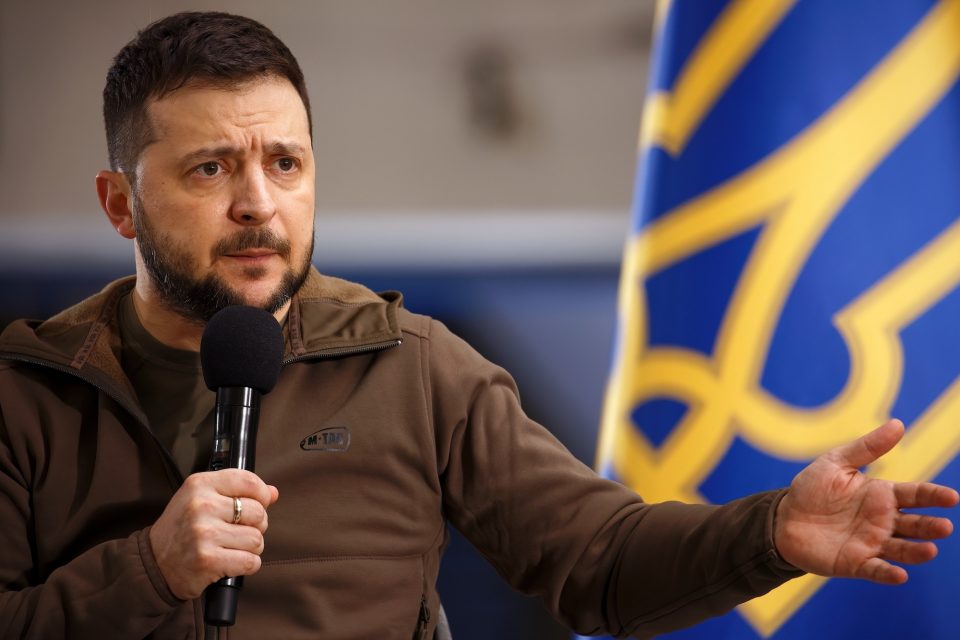
 Photo: Volodimir Zelenski/Shutterstock At the end of October, a photo of the book "My Struggle" was shared on social networks, featuring the President of Ukraine Volodymyr Zelensky on the cover. In the collage, the cover of one of the editions of the autobiography of the Nazi leader Adolf Hitler, which bears the same name (German: Mein Kampf), was also added.
 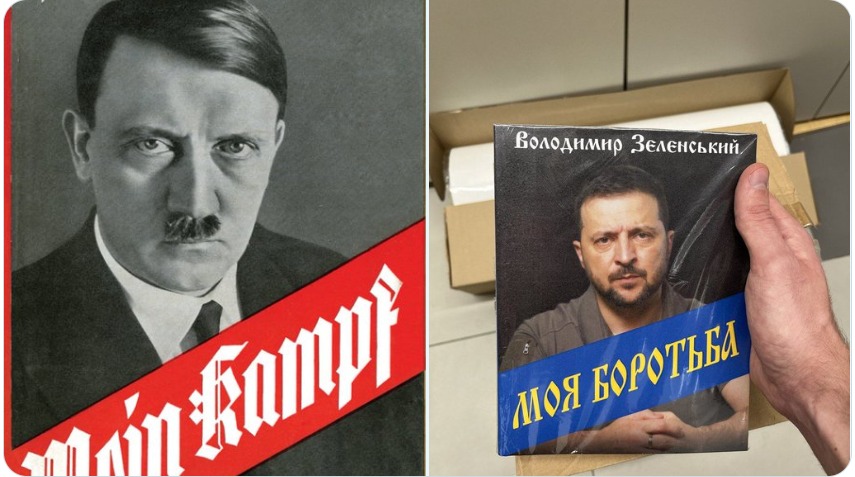 This collage was shared on Facebook (1, 2) and Twitter (1, 2, 3, 4) with descriptions claiming that Zelensky announced that he "wants to publish an autobiography with a cover design similar to Adolf Hitler's 'Mein Kampf'", while some posts contain only a photo without any description. In other cases, only claims were published in the form of tweets and without photos, suggesting that Zelensky published the book "My Struggle" (1, 2). What are the facts? The first photo from the collage, the one featuring Hitler, shows the 1941 edition of the book "Mein Kampf". As stated by the Mirror in the article published on January 3, 2017, in which the photo of this cover of Hitler's autobiography was used, a year after the reprinting of his biography was allowed in Germany, it became a bestseller with 850,000 copies sold.
 A reverse search of the second photo from the collage, the one showing the title page of the supposed book "My Struggle" by Zelensky, shows that it was shared on different, mostly Russian, sites. In the analysis published by the Czech web portal Irozhlas, which is part of the country's public service, it is stated that the photo of the cover of the book "My Struggle" by Zelensky is a photomontage. According to their analysis, this photo was also published on his Twitter account by Ivan David, a Czech member of the European Parliament from the right-wing Svoboda a přímá demokracie (SPD) party. The Embassy of Ukraine in Prague denied to Irozhlas the allegations that Zelensky published the book "My Struggle". As stated by the spokeswoman of the Embassy, Tetiana Okopna, the photo is obviously fake news.When Nazism was defeated in 1945, all of Hitler's assets—including the copyright to the book—passed into the possession of the Bavarian state, the place where his party was founded. For years, the authorities have prevented numerous attempts to publish it, fearing that the book would become a cornerstone of faith for neo-Nazis. But when the 70-year copyright expired, the state agreed to let the Institute of History print an annotated version. The new version contains copious notes explaining Hitler's paranoid racism to dissuade readers from ever believing his twisted gospel.
In its analysis, Irozhlas states that many users on various forums refer to the Colonelcassad Telegram channel as the source of the analyzed photo. It was published on this channel on October 19, 2022."Of course, such a book has not been published. This is false information. In the near future, a collection of sixteen speeches by President Volodymyr Zelensky should be published in various languages in some countries. But this book will be called 'Message from Ukraine'", explained Tetiana Okopna, spokeswoman for the Ukrainian embassy, according to whom it is an obvious "fake". The fact that Zelensky will publish a book entitled "Message from Ukraine" was reported by the British newspaper The Guardian at the beginning of the week.
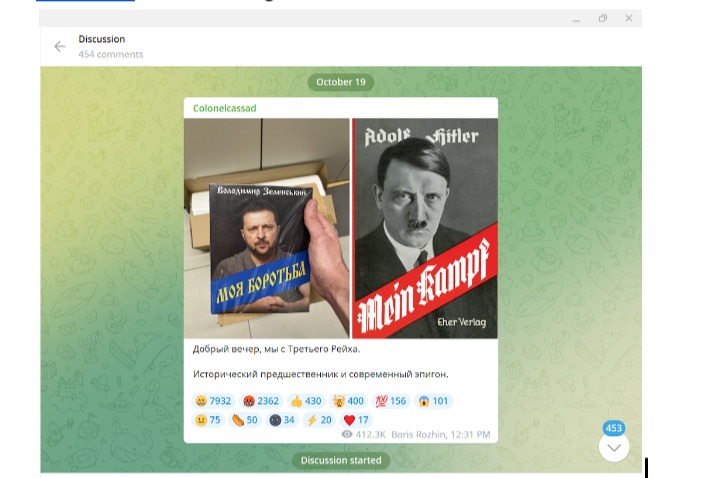 Tereza Chlaňová from Charles University also confirmed for Irozhlas that the cover is a photomontage with obvious spelling mistakes. She, like Miroslav Tomek, states in the cited analysis that there are obvious spelling mistakes in the photo that would not be possible in the actual edition. The name is not spelt correctly, and the spelling of the last name Zelensky in the way shown is typical for the Russian language, not for the Ukrainian language, as they state.
 "The form 'Zelensky’ that we see on the book cover would be phonetically close to the Russian form. This suggests that the book cover was created by a Russian who simply replaced the Russian letters with Ukrainian equivalents. No Ukrainian would write the name of the Ukrainian president like that, the difference in pronunciation is quite obvious to a native speaker", Tomek concludes.